← ELI5 中文
GOT IT AT A GLANCE

Tech launch
event jargon

For people who see "major launch!" every day and can't tell whether they can actually use it
No. 39How AI WorksPart 8 of 14
1

In one line

Tech companies treat it like a holiday: every year, on fixed dates, they hold a big event and put the new things on stage all at once. But "announced on stage" and "you can use it today" are often months apart.

2

The fixed
"holidays" of the year

Every company has its own yearly event. The names differ but the job is the same: show this year's new things all at once.

Jan
CESThe Las Vegas consumer electronics show, where companies show off new TVs and computers
Mar
GTCNvidia's event, about new graphics chips and computing power
May
Google I/OGoogle's developer conference: Android and AI
May
BuildMicrosoft's developer conference: Windows and office software
Jun
WWDCApple's developer conference, where new system software debuts
Sep
Apple fall eventThe new iPhone almost always arrives here
Fall
DevDayOpenAI's developer day: new models, new APIs, price cuts
Dec
re:InventAmazon's cloud event, about cloud services sold to companies

DevDay, WWDC, I/O and Build are "developer conferences," aimed mainly at people who write programs. Events for ordinary buyers, like new phones and computers, are usually called "launch events." Exact dates shift each year, so go by the official announcement.

3

The usual script
of a launch event

① Teasers and "leaks"A mysterious poster goes out days before, and "according to people familiar" starts circulating online. Some leaks are real accidents; some are let out on purpose.
② The big talkKeynoteThe boss goes on stage for an hour or two, streamed live. The most important things are all in this one.
③ Live show-and-tellDemoThey operate it in front of you. Note: some "live" demos are actually pre-recorded, usually with a line of small print in the corner.
④ One more thingThe surpriseNear the end they suddenly pull out another big one. It is an old trick from Steve Jobs, and now everyone copies it.
⑤ Everyone publishes at onceEmbargoReporters get the product days earlier but agree "nothing before this exact minute." The moment it hits, dozens of reviews appear together.
4

"Launched" does not
mean "usable"

A new thing usually climbs a ladder like this between the stage and your hands. When the news says "launched," it may only be on the first rung.

1
AnnouncedAnnounceThey just tell you "this exists." You can't touch it yet.
2
Waiting listWaitlistLeave your email and they notify you when it's your turn, which may take a long time.
3
Preview / test versionPreview · BetaIt works, but it isn't finished: it will break, change, and may be pulled back at any time. A "research preview" openly says "try it and see."
4
Gradual releaseRolling outSome people get it today, more get it tomorrow. If your friend has it and you don't, this is probably why.
5
Generally availableGAEveryone can use it, and the company fixes problems. Only at this rung is it truly "live."
6
Retirement announcedDeprecatedIt still works, but the company has said "we're done with it, please move out."
7
Shut downSunsetOn the date, it is switched off and can't be used anymore.
5

Reading between
the lines

"Coming in the next few weeks"
→ Could be months
Saying "weeks" leaves them room, and few arrive on time.
"Available starting today"
→ Really usable today, but maybe not for you yet
Often paired with a gradual release: the US first, paying users first.
"Available in select regions"
→ US first, everywhere else waits
Mainland China is usually not in the first batch.
"Pro / Plus users first"
→ Those who pay more go first
Free users come later, or get only a few uses a day.
"Ranked #1 on benchmarks"
→ #1 on an exam it picked itself
Every company picks the tests that favor it. Whether it's good, you have to try for yourself.
6

Words you
often see in the news

DeveloperDevSomeone who writes programs. A "developer conference" is mainly for them; everyone else just watches the show.
APIInterfaceA company opens a window onto its abilities and sells it to other programs, charging by usage. "API price cut" is news for people building software and has nothing to do with the subscription price on your phone.
Release notesChangelogA list of "what changed this time" for each update. More honest than a press release.
RoadmapPlanA chart of "what we plan to do later." A plan, not a promise.
CodenameNicknameAn internal nickname used before the official name. Leaks often contain only the codename.
Model cardSystem cardA "health check report" an AI company attaches to a new model: what it can do, what it can't, and which risks were tested.
Open weightsNot quite open sourceThe trained AI "brain" is released whole, and anyone can download it and run it on their own computer. Not exactly the same as "open source."
Rate limitUsage capThe cap on how many times each person can use it per minute or per day. Right after a new release, with the crowds, the caps are tightest.
Launch weekDrip launchOne new thing a day for several days in a row, to stretch out the buzz.
7

See "major launch"?
Find three answers first

WhenUsable today,
or "in the coming weeks"
For whomEveryone,
or paying users, the US,
developers
How muchFree,
or an upgrade to a paid plan

Once you have all three, the news is useful to you. If you can't find them, treat it as a trailer.
Launch events are for the whole world.
You only need to ask:
"Can I use it today?"
If yes, go try it. If not, wait until it climbs to "generally available." No need to rush along.
UP NEXT

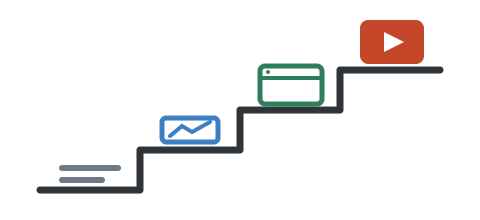
Don't Just Make AI Write

Karpathy's four steps for making AI explain things clearly: from plainer writing to diagrams, web pages, and video. Say a few words and it's done.
No. 41 · 4 minKeep going →
← Back to ELI5