
Can't play sound? The illustrated version is right below.
The full narration of the video.
Many people think an AI that watches a shop means cameras, with the smartest AI staring all day. It doesn't. Step one isn't buying gear. It's saying, in one sentence: what do you want it to do? One small-shop owner wrote just three words: AI for everything. People do people's work, machines do machines' work.
With that one sentence, every step after it has a direction. You can buy a ready-made box that watches a shop. Just plug it in. Easy — but it's sealed, and you can't change it. Building your own is harder. But it grows to fit your shop, and no store-bought box can do that.
Once the cameras catch a picture, who decides what's going on? The answer: layer by layer, like a funnel. Layer one is fixed rules. Say, the back door opens after closing time — send an alert. Fast and cheap. What the rules can't settle goes to layer two: a small model trained to do just one thing.
Still unsure? Layer three: a big model running on your own computer. No pay-per-use, but it often gets things wrong. Only then comes layer four: the smartest big model in the cloud. Most accurate, most expensive — you pay every time. Most cases are settled at layer one. So the most expensive one only steps in for the hardest calls.
One more thing goes before the funnel: the camera has to see clearly. Research shows that when a picture is blurry, AI mistakes things far more often. If a picture can't be seen, even the smartest AI can only guess. A system like this isn't installed once and done. It gets good slowly, by being used and changed again and again.
So where does the money come from? Think about walking a dog. Walk your own, it's free. Hire someone, you pay them. In Tokyo, there have even been shops that rent out dogs by the hour. People who want a dog to walk, but can't keep one, pay to walk them. Same activity, different needs — and the money flows in different directions.
So next time someone wants to use AI, don't start by asking which one is smartest. Ask first: what do you actually want it to do?
Each picture goes to the cheapest check first. Only what it can’t settle gets passed down, layer by layer. The smartest, most expensive AI comes last.
One small-shop owner wrote just three words: AI for everything. People do people’s work; machines do machines’ work.
Most cases are settled at layer one. So the most expensive one only steps in for the hardest calls.
“Cheap first, expensive later” is an old trick: a famous face-finding program from 2001 used very simple checks to throw out most of each picture, and only passed what was left to more careful checks.
A system like this isn’t installed once and done. It gets good slowly — by being used, and changed again and again.
Same activity, different needs — and the money flows in different directions.

When an AI keeps failing in the same place, the fix is often not the AI: let a second AI review old mistakes and suggest edits, and a human approves.

The AI helper you hired got a new version, and nine of its habits changed. A symptom chart: what feels off, and the one line to say for each.
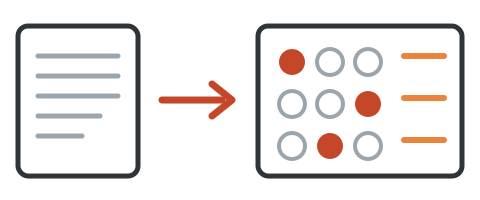
A new AI that never talks: it fills in bubbles on a printed answer sheet with a confidence note. Why it is 40-200x faster, and why it can't make things up.

Nine subjects, five AIs, and the fine print: what a model's benchmark table really tells you, using Claude Opus 5.5 as the example.