
Can't play sound? The illustrated version is right below.
The full narration of the video.
The Andromeda Galaxy is about two and a half million light-years away. No one has ever been there, and no ruler could ever stretch that far. So where does that number come from? From one measuring trick handed to the next. Like a ladder, each rung resting on the one below. You can try the first rung right now. Hold out your thumb. Close your left eye, then your right. Your thumb seems to jump against the background.
The closer something is, the more it jumps. The farther away, the less. Measure the jump, and you can work out the distance. Earth circles the Sun. Look at a star, then look again six months later. Now your two eyes are about three hundred million kilometers apart. With this trick, a satellite has measured stars within a few thousand light-years very precisely. But any farther, and the stars barely jump at all.
The second rung uses lamps. If you know how bright a lamp really is, then how dim it looks tells you how far away it is. In nineteen twelve, astronomer Henrietta Leavitt found something: a kind of star that brightens and dims. The slower it changes, the brighter it truly is. Let's call it a blinking star. Count how many days it takes to blink, and you know how bright it really is.
First, measure nearby blinking stars with the thumb trick. Now this lamp is calibrated. In nineteen twenty-three, Edwin Hubble found a blinking star in Andromeda. The math put it far outside our own Milky Way. Andromeda was another galaxy. But farther out, blinking stars are too faint to see. The third rung needs a brighter lamp: an exploding star, called a supernova.
One kind of supernova shines about the same every time. Roughly five billion times brighter than the Sun. Bright enough to outshine its whole galaxy. Find a galaxy with both blinking stars and one of these supernovas. Use the blinking stars to calibrate the supernova. Then you can measure beyond a billion light-years. For the farthest places, there's one more trick: look at the color of the light. The universe is growing. The longer light travels, the more it gets stretched, and the redder it looks.
In nineteen twenty-nine, Hubble found something: the farther a galaxy is, the redder its light. Measure how red, and you can estimate how far. So these numbers aren't measured in one go. They're built up, rung by rung. If a lower rung is a little off, every rung above it is off too. Andromeda's two and a half million light-years has an error of about five percent. And two ways of measuring how fast the universe grows still don't agree today. Scientists are still working on it.
Next time you hold out your thumb and switch eyes, remember: the first rung of the ladder that measures the universe starts with that simple move.
No ruler reaches that far.
So astronomers built a ladder:
measure what is close first,
then extend it, rung by rung.
The Andromeda Galaxy is about 2.5 million light-years away. That number comes from four rungs, each one resting on the one below.
For stars, the “two eyes” are Earth now and Earth six months later: halfway around the Sun, about 300 million kilometers apart. Europe’s Gaia satellite used this to measure about 11 million stars to within 1%, all within about 2,600 light-years. Any farther, and stars barely jump at all.
Each rung is calibrated by the one below: the thumb trick measures nearby blinking stars, blinking stars measure galaxies that host those explosions, and so on up.
One puzzle is still open: how fast the universe is growing. The ladder and the universe’s oldest light give answers about 8% apart, and scientists are still working out why.
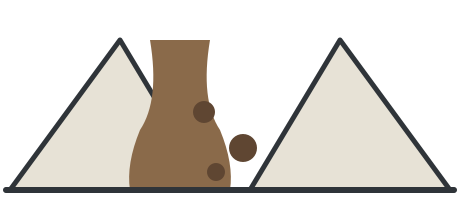
Not just "too much water": a whole gully of rock, mud and water that moves like wet concrete. What it is, the warning signs, and which way to run.

The Chinese names for kiwifruit: seeds left Yichang for New Zealand in 1904, it was renamed in 1959, and the price gap comes from variety and brand, not name.
A place where you can go in but never come out, not even light. What it is, why nothing escapes, how we 'heard' two collide, and why Earth is safe.
When sugar and protein bits get hot they "hold hands" and make hundreds of aromas and a golden color. Why boiling doesn't work, and four searing tips.