What is
Anatomy?
Can't play sound? The illustrated version is right below.
Read the transcript
The full narration of the video.
Pishen asked in the comments: what is Anatomy? First, look at two pictures. On the left, boxes joined by arrows; on the right, a lock. Both explain the very same thing. Presenting it next week, which would you pick?
Anatomy is a set of instructions: it teaches an AI to draw the picture on the right. It went online on October 8th, for free. In three days, more than twelve hundred people saved it. How does it turn an idea into a lock? Let's follow it, step by step.
Take something programmers deal with every day. Before a computer draws a picture, it checks the ingredients. If they match last time, it reuses the old picture instead of drawing again. Step one: no drawing yet. Get the facts straight: how many ingredients to check, and what happens if one differs.
Step two, invent a machine: the way it moves is exactly how the idea works. It thinks of a lock. Inside sits a row of little brass pins, and each pin is one ingredient. Slide in the key, every tooth fits, every pin lines up. The lock turns: nothing gets redrawn.
One tooth off, a pin sticks, the lock won't turn. So it honestly draws it all again. See? You got it before hearing the name. Programmers call this a cache. Step three: list the parts. Even a small picture needs at least forty.
A base, feet, screws, a ruler, a little name plate. Every part has to rest on another part. A bare slab with a few lines looks like nothing. With enough parts, you recognise a real machine. Step four: make it move. Touch it and it responds; leave it alone and it slowly plays by itself.
The numbers on the little screen come from the same ledger that moves the pins. What the picture says always matches what it does. Step five, it hunts for its own flaws: every joint is checked at four times zoom. And one more check: no pipe may pass through anything. Every line must end on something, never in mid-air.
Its most complex one is a rocket engine: touch it and it comes apart into eleven pieces, every frame checked so no pipes collide. It has weak spots too. It's slow: a small picture takes thirty to ninety minutes. No charts, no people; and an idea with no mechanism comes out weaker. Back to the start. With boxes and arrows, you first memorise what each box means. A lock, you've used since you were a kid.
You don't need rules to recognise a machine. That's the trick: the object itself is the explanation. Next time you explain something, skip the boxes and think: what machine is it like? Pishen, give it a try. Come back and tell us which machine you thought of.
Two pictures,
one idea
Next week’s meeting:
which one do you show your boss?
On the left you first have to remember what every box means. The lock on the right you’ve known how to use since you were a kid.
A manual that teaches
AI to draw the lock
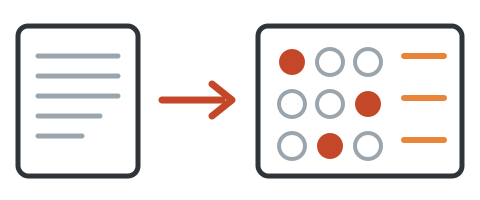
Anatomy is a manual written for AI: turn an idea into a small machine that moves. It went public on October 8, it’s free, and within three days more than 1,200 people had starred it.
An AI reads a manual like this and simply follows it — we covered how it can even rewrite its own manual.
Follow along:
drawing a lock
The example: before drawing a picture, a computer checks its ingredients. If they match last time, it reuses the last picture instead of drawing it again.
Inside the lock is a row of little brass pins, one per ingredient. When every tooth of the key fits, the pins line up and the lock turns: no redraw. One tooth off, a pin jams, and the picture gets drawn again.
You got it
before hearing its name.
Programmers call this a cache: if nothing changed, reuse what you have. See it first, name it later — that’s how good explanations work.
Five checkpoints
for every machine
Why so many parts? A bare board with a few lines looks like nothing; enough parts and you recognize a real machine. Its most complex one is a rocket engine that comes apart into 11 assemblies at a touch.
Where it falls short
takes 30–90 minutes It doesn’t draw charts or people. An idea with no mechanism to build comes out weaker.
is the explanation
Quick check
What does Anatomy teach AI to turn an idea into?
Like the lock: the pins line up and it turns only when every tooth fits, so watching it move explains the cache.