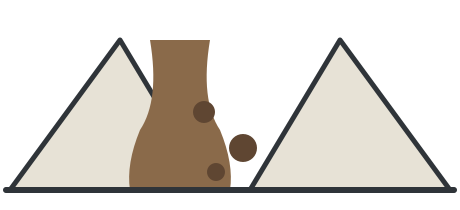
Dripping water
wears away stone
For every student who has used the saying
Can't play sound? The illustrated version is right below.
Read the transcript
The full narration of the video.
Water is soft, so how does it drip a hole into stone? Under old eaves, you sometimes find a row of little pits in the stone, right below the drips. In the Song dynasty, an official named Zhang Guaiya caught a clerk taking one copper coin from the storeroom every day.
The clerk said: what's one coin? Zhang wrote: one a day makes a thousand in a thousand days; a rope saws through wood, dripping water bores through stone. He meant persistence. But how does a drop actually take stone away? Let's fall with one and see. A drop hitting stone isn't like a hammer striking one point.
The instant it lands, it flattens into a thin pancake and races outward. Scientists have measured the forces under a drop: the strongest push isn't at the center, it rides outward with the spreading ring. That ring scrapes sideways across the stone, like a cloth wiping a table.
A sideways scraping force like this is called shear. One wipe of a cloth clears a layer of dust; one drop only carries off a few loose grains. One hit, and you'd barely notice. But a drip never comes just once.
One drop a second is eighty-six thousand four hundred a day, and over thirty-one million a year. And every one scrapes the same small patch. Scraping alone is slow, and water has a second trick.
As rain falls, it picks up a little carbon dioxide from the air and becomes a very weak acid. Limestone and marble are mostly calcium carbonate, and it gives way to acid. Eggshell is calcium carbonate too. Soak an egg in white vinegar, and the shell fizzes with tiny bubbles and slowly softens.
Rain is far weaker than vinegar, and one soak does almost nothing; but the same spot gets soaked for centuries. The acid loosens the surface and the drops scrape it off; each layer gone exposes a fresh one to soak. One loosens, one scrapes, and the pit deepens bit by bit.
So it's not that any drop is strong, it's that the same spot gets hit millions of times. Look back at the saying, and there's one more lesson inside. Raindrops land everywhere, their effort spread thin, and the stone just ages evenly.
Eave water hits the very same point every time, and that's what makes a pit. Persistence isn't enough; you have to keep aiming at the same place. Stranger still, water also builds stone.
In caves, water seeps down carrying dissolved stone, leaves a tiny bit behind before each drip falls, and over ages that grows into a stalactite. If you were that stone, which would scare you more: one big storm, or little drops all year round?
In one line
Most people think dripping water hammers the stone. In fact each drop flattens into a thin pancake and scrapes sideways along the surface, while a trace of acid in rainwater softens the rock. Tens of millions of drops on the same spot, and a pit appears.
What you think
vs what happens
Put simply: like wiping a table with a cloth. A force that scrapes along a surface is called shear stress.
How the pit
grows, bit by bit
A few
surprising numbers
Persistence
is not enough
Water can also build stone. In caves, water carrying dissolved rock drips from the ceiling, leaves a tiny bit behind each time, and over ages grows a stalactite.
Quick check
When a drop hits stone, where is the biggest force?
The drop flattens and spreads, and its edge scrapes sideways along the surface, so the peak force travels outward with it.