What does it take to lose half a kilo of pure fat?
Can't play sound? The illustrated version is right below.
Read the transcript
The full narration of the video.
What does it really take to lose one jin, half a kilo, of pure fat? The energy it holds could carry a sixty-kilo person seventy-five kilometers. That's almost two marathons.
Think of your body as a household. Food is income. Heartbeats, breathing, walking: those are expenses. Whatever isn't spent gets saved. And the body's savings account is fat. It's packed tight. One gram of pure fat stores nine kilocalories. Half a kilo stores four thousand five hundred.
You've seen these units on snack packs. Chinese labels use kilojoules. Divide by four point two to get kilocalories. An adult spends about two thousand to two thousand five hundred a day. So half a kilo of pure fat could cover two whole days without a bite.
So can two days of starving burn it off? When money gets tight at home, people cut back: fewer lights on, fewer trips out. Your body does the same. Eat less, and it turns its spending down. Even lying still, it burns less.
So real weight loss is usually slower than the math says. And the scale can fool you. The fast drop in the first few days is largely water that leaves with stored sugar. Not fat. With the books balanced: where does that fat actually go?
Spent money ends up in someone else's pocket. Spent fat gets taken apart and burned. Fat is built from three atoms: carbon, hydrogen and oxygen. Burning it takes oxygen. Burning half a kilo of fat takes nearly one and a half kilos of oxygen.
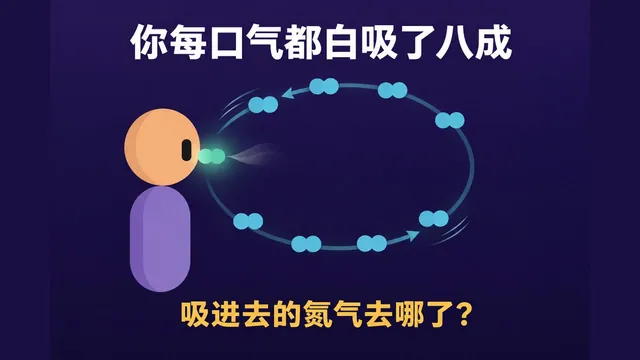
Out come two things: about one point four kilos of carbon dioxide, and over half a kilo of water. The water leaves slowly, in urine and sweat. The carbon dioxide leaves one breath at a time. By weight, more than eighty percent of that fat leaves through your mouth.
But breathing harder won't help. Fat only breaks down when the body actually spends energy. The lungs are just the exit. Starving isn't the way. If you have a health condition, follow your doctor. Losing half a kilo of pure fat means spending four thousand five hundred kilocalories, then breathing it out, one breath at a time.
Where did you think lost weight went?
Half a kilo of fat
could fuel a 75 km run
One gram of pure fat stores 9 kilocalories. A jin, the Chinese pound, is 500 grams: that makes 4,500 kcal.
A 60 kg person burns about 60 kcal per kilometer of running. 4,500 kcal would carry them 75 km: almost two marathons.
That is an energy comparison. Running does not burn only fat, so a real 75 km run would take off less than half a kilo of it.
Your body is a household;
fat is the savings
Food is income. Heartbeats, breathing and walking are spending. Whatever is not spent, the body saves as fat.
You have seen these units on snack packs. Chinese nutrition labels list energy in kilojoules; divide by 4.2 to get kilocalories. "Energy 2100 kJ" is 500 kcal.
An adult spends roughly 2,000 to 2,500 kcal a day. So half a kilo of pure fat could cover two whole days without a bite.
Why two days of starving
won't do it
The scale can fool you too. The quick drop in the first few days is largely water held with stored sugar (glycogen), not fat. It is the same reason the scale goes up after training: see why thin people gain weight at the gym.
In the end, it leaves through your mouth
Spent money ends up in someone else's pocket. Spent fat is taken apart and burned. It is built from carbon, hydrogen and oxygen atoms, and burning it takes oxygen.
Burning half a kilo of fat takes nearly 1.5 kg of oxygen and yields about 1.4 kg of carbon dioxide plus a little over half a kilo of water. The water leaves slowly in urine and sweat; the carbon dioxide leaves one breath at a time.
By weight, more than 80% of the fat leaves through your mouth.
How cells take food apart bit by bit and release heat: where body heat comes from.
Breathing harder
won't slim you
Quick check
Where does most of the fat you lose actually go?
Like savings being spent: fat is taken apart and burned, and over 80% of its weight leaves as carbon dioxide, one breath at a time.