
Can't play sound? The illustrated version is right below.
The full narration of the video.
You tap the screen, and a photo opens. In that moment, what did the tiny chip inside your phone actually do? Start with the smallest part: a switch. A chip is packed with tiny switches. Power on means one, power off means zero. The chip in one iPhone holds nineteen billion of these switches.
One switch can only turn on or off. But put two switches in a row, and they can make a decision: the light comes on only when both are on. Connect more of them, and they can add. One plus one is two, which the chip writes as one, zero. But doing math isn't enough. How does the chip know what to do next? It follows a list.
Every app you install is really a very long list. Each line says one small thing: grab a number, add. Store it, or jump to another line. Inside the chip is a bookmark that remembers which line comes next. It does just three things, over and over. Follow the bookmark and fetch a line. Work out what that line asks for. Do it. Then the bookmark moves down, and it starts again.
Who calls the next step? A metronome. With every beat, all the switches move forward one step together. In 1971, the first microprocessor anyone could buy had just 2,300 switches. Its metronome beat 740,000 times a second. Today's phone chip has over eight million times as many switches, and can beat more than three billion times a second.
So the chip doesn't think. It just follows the list: fetch, understand, do, astonishingly fast. Every tap, swipe and photo you take. Behind it are billions of switches, beat by beat, working through that list for you.
A chip is billions of tiny switches, flipping on and off at incredible speed as they follow a list, one line at a time.
Gold switches are “on” (that counts as 1); grey ones are “off” (that counts as 0).
Put simply: a switch can’t compute. The way switches are wired together can.
Every app you install is really a very long list. Each line says one small thing: grab a number, add, store it, or jump to another line. Inside the chip is a bookmark that remembers which line comes next.
Who calls “next”? A metronome, the chip’s clock. With every beat, all the switches move forward one step together.
“A phone today” means the chip in Apple’s 2023 iPhone 15 Pro.

Using a sign-up page for a seafood dinner: walls, paint, switches, a shared notebook and a street address, no code required.
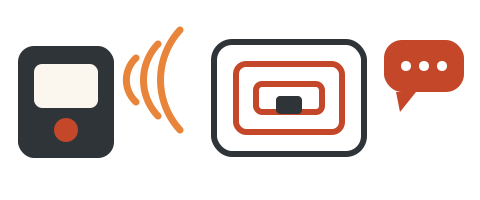
Key cards, hotel cards and anti-theft tags are the same trick: a battery-free tag that shouts its number back when a reader pings it.
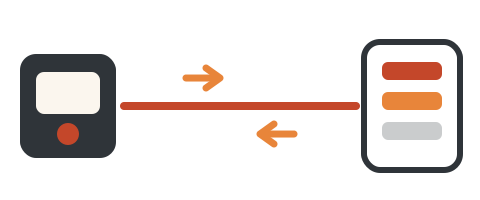
WebSocket for total beginners: from "ask every five seconds" to "the other side shouts the moment something happens."
The whole toolkit: repos, commits, branches, pull requests, green squares. Treat it as save files in a video game and most of the jargon makes sense.