
Can't play sound? The illustrated version is right below.
The full narration of the video.
Someone built a computer inside the game Minecraft. It's as big as a city, and takes just one step per second. How can blocks in a game turn into a computer? Start with a special block called redstone. Lay it out in a line. Pull a lever at one end, and a lamp lights up at the other.
It works like a wire. A signal is either there or not: the lamp is either on or off. Add one more little part: a redstone torch. Signal in, it goes dark; no signal, it lights up. Its whole job is to flip the signal. Put a few wires and torches together, and they can make tiny decisions. For example: the lamp lights only when both levers are pulled.
That's the smallest building block of a computer: a little switch that can only answer “yes” or “no.” The chip in your phone holds billions of these little switches. Each one is too small to see. In the game, one switch takes up several blocks. So a computer has to be built as big as a city.
Back in 2010, a player built the first machine in the game that could do math. Since then, more and more of these computers have been built. The most famous one is called CHUNGUS 2. One player built it over seven months, between school classes. It takes only one step per second. Yet it really can play Tetris and Snake. It can even draw math graphs.
One step a second is far too slow. So players wrote a speed-up program that makes redstone run over ten thousand times faster. In 2022, he and two friends went further: on this computer inside the game, they ran Minecraft itself. The screen is just 96 by 64 squares, in two colors. But you really can dig blocks and craft things in it.
Even sped up more than ten thousand times, it takes ten seconds to draw one picture. Without the speed-up, it takes days. In 2025, he built a little chatbot. It used more than 400 million blocks. Even forty thousand times faster, for one reply, you still wait about two hours. Is it a real computer? Yes. It works just like your phone: a huge pile of switches, flipping on and off, step by step. Just much slower.
And it's no hidden shortcut in the game. Every switch was placed by players, one block at a time. Next time you pick up your phone, think about this: behind that little screen are billions of switches, too, flipping billions of times a second. Seen anyone build something wild inside a game? Tell me in the comments.
Players use game blocks that carry a signal to place thousands of tiny switches, one block at a time. With enough switches, it becomes a computer that can do math.
Same idea: a huge pile of switches, flipping on and off, step by step. Only the size and speed are different.
Minecraft inside Minecraft: the screen is only 96×64 squares in two colors, but you really can dig and craft. Even sped up over ten thousand times, it shows one new picture every ten seconds.

No fan, yet the battery lasts longer. Three tricks explain it: don't rush, split the work, and move everyone into one room.

Using a sign-up page for a seafood dinner: walls, paint, switches, a shared notebook and a street address, no code required.

Key cards, hotel cards and anti-theft tags are the same trick: a battery-free tag that shouts its number back when a reader pings it.
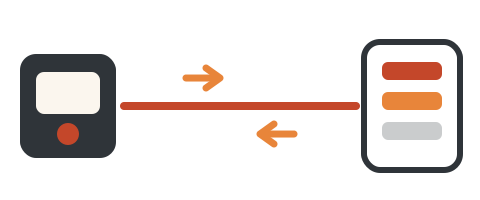
WebSocket for total beginners: from "ask every five seconds" to "the other side shouts the moment something happens."