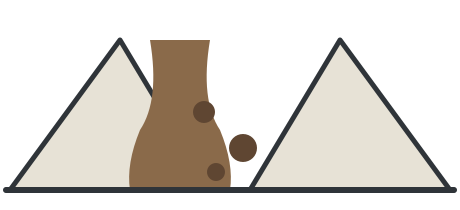
Why do big buildings love revolving doors?
Can't play sound? The illustrated version is right below.
Read the transcript
The full narration of the video.
Walk into a tall building in winter and push the ordinary glass door: it's so heavy you need your shoulder. Open it, and cold air rushes in. Take the revolving door beside it: half a turn, and there's barely a breeze behind you. Same building. What's the difference? The answer has to do with an invisible chimney.
First guess: is it just for show? But its first American patent, granted in 1888, was called a storm-door structure. So it's about wind. But it isn't windy outside. Where does it come from?
From inside the building. In winter, it's warm inside and cold outside. Warm air is light. It rises up the elevator shafts and stairwells, and slips out through gaps at the top. What leaves at the top gets replaced at the bottom: cold air is sucked in through the ground-floor doors.
The whole building is one big chimney. The taller it is, the harder it pulls. That pull presses on the door, which is why it's so heavy. Open an ordinary door, and inside and outside become one straight path.
A revolving door is different. It works like a canal lock. To go from high water to low, a boat enters the lock. The gate behind it closes before the gate ahead opens. The water can never rush straight through, because at every moment, one gate is shut.
The panels of a revolving door are gates that travel in a circle. You step into a slot, with panels before and behind you. You come out the other side, and the slot behind you is sealed again. At any angle, there's no straight path through. A revolving door is always closed.
How much does it help? In 2006, a group of MIT students counted people at one building's doors and did the math. The swing door let in up to eight times as much air as the revolving door. But only about one person in four used it. If everyone did, the building would save about one and a half percent of its heating and cooling energy a year.
Where the lock comparison breaks down: a lock lets one boat through at a time, but a revolving door keeps turning, and every slot still carries a little pocket of air across. So it does leak. Just much less. So if it's so good, why is there always an ordinary door beside it?
In 1942, a nightclub in Boston caught fire. 492 people died. The revolving door at the main entrance jammed with panicked people. It was one reason so many couldn't get out. Since then, American revolving doors have panels that fold flat with a push. China's fire code says escape doors can't be revolving doors.
Every day, the revolving door keeps the wind out. In an emergency, use the ordinary door beside it. Next winter, when someone opens a building's ordinary door, hold a tissue up by the doorway. Then come back and tell us: did it flutter into the building, or out?
Same building, two very different doors
Walk into a tall building in winter and push the ordinary glass door: it's so heavy you need your shoulder, and when it opens, cold air rushes in. Take the revolving door beside it: half a turn, and there's barely a breeze behind you.
It isn't just for show.
The first American patent for a revolving door, granted in 1888, was called a "Storm-Door Structure". A few years earlier, a German version was patented as a "door without draft".
The whole building is one big chimney
The taller the building, the harder it pulls. That pull presses on the door, which is why it's so heavy.
In summer, with the air conditioning on, it runs the other way: cool air sinks and leaks out the doors, though usually more weakly. For why the same indoor temperature feels different in summer and winter, see why 23 degrees feels cold in summer and warm in winter.
A revolving door works like a canal lock
To go from high water to low, a boat enters the lock chamber. The gate behind it closes before the gate ahead opens. The water can never rush straight through, because at every moment one gate is shut.
The panels of a revolving door are gates that travel in a circle. You step into a slot with panels before and behind you; you come out the other side, and the slot behind you is sealed again.
At any angle, there's no straight path through. A revolving door is always closed.
Where the comparison breaks down: a lock lets one boat through at a time, but a revolving door keeps turning, and every slot still carries a little pocket of air across. So it does leak, just much less.
Counting people at one building's doors
From a 2006 study by MIT students who counted people at the doors of one campus building. It's an estimate for one building; other buildings and climates will differ.
The ordinary door next to it is for escape
Quick check
Why does a revolving door keep out the cold air that rushes into buildings in winter?
Like a canal lock, there's always a panel shut, so air can't rush through. Only a small pocket gets carried across with each slot.