What are quarks
and string theory?
Can't play sound? The illustrated version is right below.
Read the transcript
The full narration of the video.
Nobody has ever seen a single quark, yet quarks count as real. String theory has been worked on for decades, and it is still a guess. Start with a grain of salt and look inside. Salt is built from atoms. Each atom has a tiny nucleus at its center, packed with protons and neutrons. Is there anything inside a proton? Around 1968, physicists used electrons like balls and fired them hard at protons.
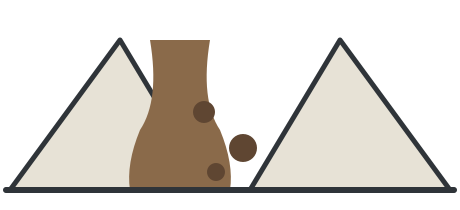
Picture throwing tennis balls into a black cloth bag. If the bag held only cotton, the balls would slip through. But some balls bounced off hard. So the bag must hide a few small, hard points. Later they counted them: three inside every proton. Those three points are quarks. Throwing things in and watching how they bounce is called scattering. The balls are electrons, the bag is a proton, the hard points are quarks.
Quarks are tied up so tightly that you can't pull one out to look at. But the balls bounced exactly the way the theory said, every time, and that was enough. In 1990, the three people who led the experiment won the Nobel Prize. String theory guesses one step deeper. Zoom in on a quark or an electron, it says, and you won't find a point, but a tiny vibrating string. Different vibrations make different particles, the way one guitar string plays different notes.
The trouble is, strings are tiny. Blow a proton up to the size of the Earth, and a string would still be a thousand times smaller than an atom. To see something that small, you have to throw much harder. The most powerful collider today is a ring 27 kilometers around. It falls short by a factor of a million billion. A rough estimate: with today's magnets, that machine would have to be over a thousand light-years long.
There's one more problem. String theory comes in countless versions that can fit almost any result. So experiments can neither prove it right nor show it wrong. Still, the math wasn't wasted. Physicists borrowed it to estimate how sticky a soup of melted quarks is, and the answer came close to experiments. Back in school, at what point did physics stop making sense to you?
One counts as real,
one is still a guess
Nobody has ever seen a single quark, yet quarks count as real. String theory has been worked on for decades, and it is still a guess.
The difference isn’t whether we’ve seen it. It’s whether an experiment can check it.
Throwing balls
into a black bag
Around 1968, physicists used electrons like balls and fired them hard at protons.
If the bag held only cotton, the balls would slip through. But some bounced off hard. The bag had to hide small, hard points. Later they counted them: three in every proton.
Those three points are quarks.
Throwing things in and watching how they bounce is called scattering. The balls are electrons, the bag is a proton, the hard points are quarks. Real experiments don’t aim at single points; they count millions of hits and see which directions the balls fly off in most.
Can’t pull one out,
still counts
Quarks are tied together by gluons so tightly that no one has ever pulled a single one out. A proton is two "up" quarks plus one "down" quark.
But the balls bounced exactly the way the theory predicted, every time, and that was enough. In 1990, the three people who led the experiment won the Nobel Prize in Physics. To meet more particles, see the episode on elementary particles.
String theory guesses
one layer deeper
String theory says that if you zoom in on a quark or an electron, you won’t find a point but a tiny vibrating string. Different vibrations make different particles, the way one guitar string plays different notes.
Too small
for any ball
To see something that small, you have to throw much harder. The most powerful collider today sits under Geneva, a ring 27 kilometers around. To see a string, it would need about a million billion times more energy. A rough estimate with today’s magnets: a machine over a thousand light-years long.
There’s one more problem: string theory comes in countless versions that can fit almost any result. So for now, experiments can neither prove it right nor show it wrong.
"Can’t be proven" means right now. Some physicists are looking for indirect tests; nothing is settled yet.
The math
wasn’t wasted
Physicists borrowed string theory’s math to estimate how sticky a "soup" of melted quarks is. The answer came close to what collider experiments measured. Nobody has found a string yet, but the toolkit already earned its keep.
Quick check
Nobody has ever seen a single quark. Why do physicists say quarks are real?
Like tennis balls thrown into a black bag: you can't see inside, but they keep bouncing off hard points. Strings are too small to hit.