How Does a
Tsunami Form?
Can't play sound? The illustrated version is right below.
Read the transcript
The full narration of the video.
There's a kind of wave that's less than a meter tall out at sea. People on boats don't even notice it. But when it hits land, it can stand taller than a building several stories high. It's called a tsunami. How does a wave under a meter tall become a wall of water? Let's follow it, from the seafloor to the shore. First stop: the seafloor. Earth's surface is pieced together from giant slabs of rock. They're always moving. A few centimeters a year, about as fast as your fingernails grow.
In some places, one slab dives beneath another. The edge of the top slab gets stuck and bends down with it, like pressing down on the end of a ruler. It can stay bent for hundreds of years. Then one day it slips, and the ruler snaps back. That's a great earthquake. In Japan in 2011, the seafloor near the trench lurched about fifty meters east, and rose by several meters.
Second stop: the surface. When the seafloor jumps, the water above it, kilometers deep, is lifted all at once. Like jerking your hand up at the bottom of a bathtub: the whole tub sloshes. Wind waves only stir a thin layer on top. A tsunami moves the whole column of water, from seafloor to surface. Third stop: the open ocean. The lifted water falls back and spreads out in every direction. In the deep sea it's about as fast as a jet plane. Close to nine hundred kilometers an hour.
But it's very low, and very long. The crest is under a meter, and the next crest can be over a hundred kilometers away. A ship on top just feels itself slowly lifted, then lowered. And it barely tires. In 2004, the Indian Ocean tsunami ran for seven hours. Five thousand kilometers away on Africa's east coast, it still took about three hundred lives. Last stop: the shore. As the water gets shallower, the wave slows down. But the water behind it keeps rushing in.
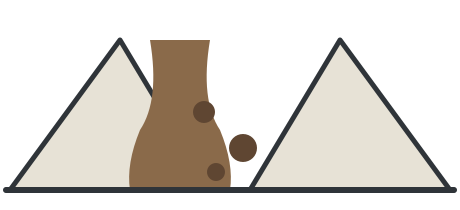
It's like highway traffic. The cars in front slow down at the toll booth, and everyone behind piles up. Squeezed together with nowhere to go, the water grows upward. That's how a wave under a meter tall piles up into a wall of water. In 2011, at one spot in Japan, the water reached forty meters. About thirteen stories. Sometimes, before the wave arrives, the sea pulls far back, exposing the seafloor and flopping fish. That's the low part of the wave arriving first. Don't pick up the fish. Run to high ground, now.
But the sea doesn't always pull back first. And a tsunami isn't one wave but a series; another may come tens of minutes later. So a tsunami isn't one big curling wave. It's the whole sea rising onto land, without stopping. Before watching this, what did you think a tsunami looked like?
In one sentence
The seafloor jolts up
and lifts the whole sea;
at the shore, it piles up higher and higher.
The bent ruler
under the sea
Earth's surface is pieced together from giant slabs of rock. They move a few centimeters a year, about as fast as your fingernails grow (why they move has to do with the heat deep inside Earth).
In some places, one slab dives beneath another. The edge of the top slab gets stuck and bends down with it, like pressing down on the end of a ruler. It can stay bent for hundreds of years, until it slips and snaps back. That's a great earthquake.
In the 2011 earthquake in Japan, the seafloor near the trench lurched about fifty meters east and rose by several meters.
Not just the surface:
the whole column moves
moves at once
At sea: fast
as a jet, too low
to notice
At the shore:
a traffic jam
In 2011, at one spot in Japan,
the water reached forty meters,
about thirteen stories.
If the sea suddenly
pulls back, skip the fish
The sea doesn't always pull back first (only about 4 in 10 times). And a tsunami is a series of waves, sometimes tens of minutes apart, so don't head back after the first one.
Closest to China: the Manila Trench, on the eastern side of the South China Sea, is the biggest potential tsunami source for southern China's coast, though the chance is low.
what did you think
a tsunami looked like?
It's the whole sea rising onto land, without stopping.
Quick check
Why does a tsunami get so tall at the shore?
Like traffic at a toll booth: the front slows down, everything behind piles up, and the water can only go up.