Are there edge computers in the cloud?
Can't play sound? The illustrated version is right below.
Read the transcript
The full narration of the video.
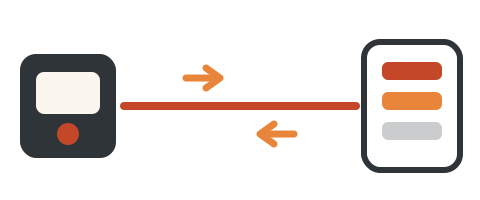
Many people think cloud and edge are opposites: the cloud is far away, and the edge is right next to you. So is there a computer that's in the cloud and at the edge? Yes. If you watch videos on your phone, you're probably using one. Let's follow one swipe. Your finger flicks, and your phone heads out to fetch the next video.
Fetch it from where? First, the cloud. It's not in the sky. It's buildings packed with computers. You don't buy them. You rent them, like renting a car: pay for what you use. That way of using computers is called the cloud. These buildings are huge and expensive, so there are only a few. Some are hundreds or thousands of kilometers away.
Does distance matter? Signals race through glass fiber at 200,000 kilometers a second. Yet even that fast, a 1,000 km round trip takes 10 milliseconds. That's one hundredth of a second. With all the detours and junctions, it's often tens of milliseconds. Your phone asks back and forth several times, and the screen starts spinning.
Light can't go any faster. So move the computers closer. Cloud companies go city by city, putting small cabinets of computers in the buildings of the company that wires your home. That ring of small rooms closest to you is the edge: the rim of the whole network, right beside you.
Popular videos already have a copy stored there. You swipe, and it's handed over from your own city. Back to car rental. One rental company has a giant lot at the airport, and a little branch by your neighborhood. Same company, same way to rent, just closer to you.
So cloud is about how you use it, rented and pay as you go. Edge is about where it is, close to you. They were never opposites. How many little branches are there? Alibaba Cloud says it has opened over 900 worldwide, in every province of mainland China. Another company has computers in over 340 cities. It says 95 percent of internet users are within 50 milliseconds of one.
Amazon even puts computers inside mobile carriers' buildings, so your request is caught before it leaves the phone network. So do we still need the big buildings? Yes. The small rooms can't hold everything or carry the heaviest jobs. Keeping ten years of your photos, or teaching a big AI model, happens back at the buildings. The near ones save time, the far ones do the heavy lifting.
So the cloud isn't in the sky. It's cut into many pieces, and one of them is in your city. Where did you think the cloud was? In the sky, on a satellite, or in one big room? Tell us in the comments.
Are cloud and edge opposites?
Many people think the cloud is far away and the edge is right next to you, so the two are opposites.
So is there a computer that's in the cloud and at the edge? Yes. When you watch videos on your phone, you're probably using one.
The cloud isn't in the sky. It's buildings.
The "cloud" is really buildings packed with computers (and they use a lot of power).
You don't buy the computers. Like renting a car, you pay for what you use.
That way of renting computers is what "cloud" means. The buildings are huge and expensive, so there are only a few, and some are hundreds or thousands of kilometers away.
Too far away, and the screen spins
Signals race through glass fiber at 200,000 km a second. Yet even that fast, a 1,000 km round trip takes 10 milliseconds, one hundredth of a second.
Add detours and junctions, and it's often tens of milliseconds. Your phone asks back and forth several times for one video, and the screen starts spinning.
Light can't go any faster. So move the computers closer.
Moved into your city: that's the edge
Cloud companies go city by city, putting small cabinets of computers inside the buildings of the company that wires your home.
That ring of small rooms closest to you is the "edge": the rim of the whole network, right beside you.
Popular videos already have a copy stored there. You swipe, and it's handed over from your own city.
One rental company, two kinds of branches
Same company, same way to rent, just closer to you.
Cloud is about how you use it: rented, pay as you go. Edge is about where it is: close to you.
So they were never opposites. An "edge computer in the cloud" is simply a rented computer that's close to you.
There are lots of these little branches
All numbers are published by the companies themselves.
Do we still need the big buildings? Yes
Quick check
What do "cloud" and "edge" each describe?
Like one rental company: the big airport lot and the little neighborhood branch both rent cars, the branch is just closer.