
Can't play sound? The illustrated version is right below.
The full narration of the video.
Two places, both getting a wave of data centers. In one, household power bills didn't rise, and even dipped a little. In the other, bills clearly went up. So which is it, up or down? The answer: it depends on three things. First, what's a data center? It's a building packed with computers, crunching day and night, and eating a huge amount of electricity.
Think of the power grid as a city bus. Buying the bus, paving the road, paying the driver: most of that cost is fixed. Three riders or thirty, it costs about the same. Say the bus is only half full. A big customer shows up and buys a whole stack of tickets. Now the fixed cost is split over more tickets, so each ticket gets cheaper.
Electricity works the same way. Wires, poles, substations: spread those big costs over more electricity, and each unit gets a bit cheaper. Berkeley Lab in the US went through the numbers state by state. From 2019 to 2025, the states where electricity use grew fastest saw average prices fall, after adjusting for inflation. North Dakota is one example. Data centers moved in one after another. After inflation, its power prices fell instead of rising. And households weren't left worse off.
But what if the bus is already full? Another big customer means buying new buses and building new roads. New buses are expensive, and they don't arrive overnight. Everyone scrambles for seats, and fares go up. The eastern US has one huge grid that powers sixty-seven million people. Data centers arrived so fast that power plants couldn't keep up.
Each year it holds an auction to reserve enough power-plant capacity ahead of time. In the 2024 auction, the price jumped to more than nine times what it had been. The grid's independent watchdog ran the numbers: over the last three auctions, about forty-seven billion dollars in total, and more than forty percent of it traces back to data centers. That money ends up in everyone's power bill. In Washington, D.C., households paid around twenty dollars more a month, and about half of that came from the auction.
The third thing is how the bill gets split. The same new cost can be charged mostly to the big customer, or spread across every household. That's why more and more places are writing new rules: whoever brings the new costs pays more of them. So data centers don't automatically make power cheaper. They don't automatically make it pricier either. Watch three things: are there empty seats? How costly are new buses? And who pays?
Next time you hear a data center is coming near you, ask one more question: does the grid have empty seats? Who pays for the new costs? Is there a data center near you? Has your power bill changed? Tell us in the comments.
Two places get a wave of data centers. In one, bills go down. In the other, they go up. It comes down to three things.
All the examples below come from the US, where the most data centers have gone up lately and the numbers have been checked most closely.
This really happened. Berkeley Lab in the US went through the numbers state by state: from 2019 to 2025, the states where electricity use grew fastest saw average prices fall, after adjusting for inflation.
North Dakota is one example: data centers moved in one after another, prices fell after inflation, and households weren't left worse off.
The same new cost can be charged mostly to the big customer, or spread across every home.
So more and more places are writing new rules: whoever brings the new costs pays more of them. In 2025 alone, US state regulators approved 29 special rate rules for very large power users, more than in the previous seven years combined.

Jim Rohn's 1981 ten-minute talk: your income can't outgrow you, plus three things you can start on today.

The marshmallow test was overturned: kids who eat it aren't weak-willed, they just don't trust promises. How two worlds grow apart, and what changes things.
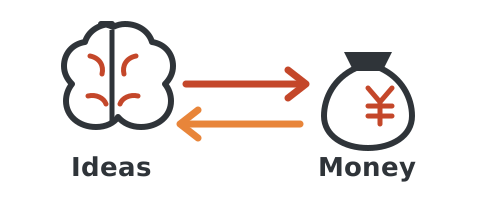
Does your thinking decide your wallet, or your wallet decide your thinking? Neither: it is a loop, and loops can be pushed.
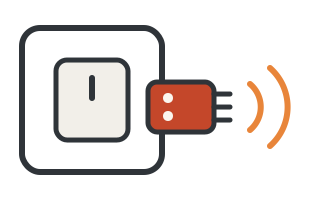
The "smart" in smart switches and plugs is a bought-in part. Plus three things worth knowing before you buy.