
Can't play sound? The illustrated version is right below.
The full narration of the video.
What does the Saha equation actually calculate? Picture a packed dance floor. Couples everywhere, holding hands. Each couple is like an atom. The big one in the middle is the nucleus. The little one spinning around it is the electron. The faster the music, the harder everyone bumps. Bump hard enough, and the little one lets go and runs off. An atom losing its electron has a name: ionization.
But the runaway keeps moving around, bumps into another big one, and grabs hold again. Some let go, others reconnect. The Saha equation tells you, once the two balance out, how many couples are split apart. It looks at just three things. First: how hot is it? The hotter, the more couples split.
Second: how crowded is it? The more crowded, the sooner a runaway bumps back into a partner, so fewer stay apart. Third: how tightly do they hold on? Helium holds on very tight. Hydrogen is in the middle, and sodium lets go at the slightest bump. In 1920, the Indian physicist Meghnad Saha wrote down this equation. What he wanted to understand was the light of the Sun.
Spread starlight out, and you find dark lines, like a barcode. Each kind of atom, split or not, leaves its own pattern of lines. Thanks to the Saha equation, astronomers could read a star's temperature from its barcode. Blue-white stars are the hottest. Red stars are the coolest. In 1925, a young astronomer named Cecilia Payne used it to find that stars are made almost entirely of hydrogen and helium. Many didn't believe her at the time. She turned out to be right.
The equation even works backwards in time. When the universe was young, it was so hot that every couple was split. About 380,000 years later, it cooled to around 3,000 degrees. The couples joined hands again, and light could finally shine through. Every star in the night sky is a giant dance floor. Read who's holding hands, and without ever going there, we know how hot it is and what it's made of.
In a hot gas, atoms are like dance partners holding hands. The Saha equation works out how many have let go, given how hot and how crowded it is.
Put simply: starlight is a letter, and the Saha equation is the dictionary.
Today's accepted numbers: our galaxy is about 74% hydrogen and 24% helium. Everything else adds up to just 2%.

Water turns into vapor at any temperature. When warm, vapor-filled air meets cooler air, the extra condenses into tiny droplets—that's the mist you see.
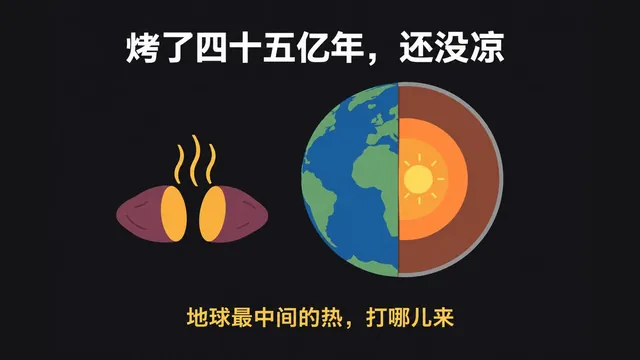
Earth's core is about as hot as the Sun's surface. Most of that heat was stored up when the planet was born, and it still hasn't cooled after 4.5 billion years.

To your eye, most nebulas are a faint gray smudge. The light and shapes in photos are real; some colors are true, some are translated.

In September an AI claimed to crack this million-dollar puzzle about flowing water. It isn't official yet, and it only covers the half where the water is pushed.