← ELI5 中文
GET IT AT A GLANCE

The work is done
but nobody
can see it

For people who don't code, starting from a real incident
No. 15Thinking ClearlyPart 3 of 12
1

The short version

The costliest mistake isn't the kind that throws an error on the spot. It's the one where everything ran smoothly and the thing still never reached where it belongs.

A mistake that raises an error gets fixed in five minutes. A mistake that stays quiet can hide for days.

2

The scene:
one shared
prep counter

Picture a kitchen with one prep counter. Only one set of work can sit on it at a time. Normally it holds "today's regular dishes," and anyone who walks in assumes they should carry on with that.

BEFORE
Only one person at a time
If I clear the counter and put my own stuff there, no problem. I'm the only one in the kitchen anyway
NOW
Several helpers at once
I swapped the counter and nobody else knows. They walk in, see the counter, and assume it's today's regular dishes

In short: the counter is shared, but it looks exactly like a private one.

3

What happened
that day

1. The counter held regular dishesAnyone walking in assumes they work on this set
2. I swapped in my own jobI wanted to try a new method, so I cleared the counter on the spot
3. Another helper walked inThey didn't check whose work was on the counter, and nobody would
4. They put their work on top of mineThey thought they were handing it to the regular dishes. They actually handed it to my half-finished tray

A true story: that day three jobs landed exactly where nobody would look. Nothing was lost, but it only came to light when someone asked, "Wasn't this finished? Where is it?"

4

Why this kind
of mistake is
so sneaky

Nobody says stopNot one warning that you did anything wrong
Checks all passEverything that should be checked was, and it's all green
Nothing is lostIt's sitting there fine, just in the wrong place
Found days laterAnd only because someone asked

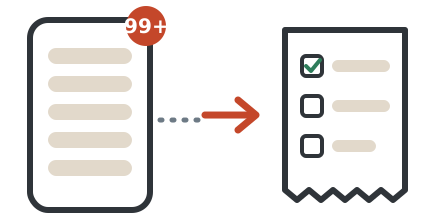
Between "finished" and "arrived" there is one more step. That step never raises an alarm by itself.

5

The same flaw,
as it looks
in a shop

This isn't unique to computers. It shows up anywhere several people share something that can't speak up:

Prep in the wrong fridgeIt's in the building, but whoever needs it can't find it
Expense form never handed inYou think it's filed, and the money never moves
Shouted, no replyYou can't tell whether anyone heard
Delivery nobody signed forIt's not in the books, so the stock count won't add up

The pattern is the same: the action happened, the echo didn't. With no echo, people assume it worked.

6

Two rules
to keep it
in check

RULE ONE
Don't put your own work on the shared counter To try something new, set up your own small table beside it. Leave the shared one exactly as it was, because the next person who walks in will work from it.
RULE TWO
Before you hand anything in, check whose counter it is One glance is enough. If something looks off, stop and ask first. Don't keep stacking on top of someone else's half-finished work.
Not lost, just not there These mistakes can almost always be recovered. The real cost isn't lost stuff; it's that for those days everyone believed it was already done, so a chain of later work was built on a false assumption.
WHAT THIS IS CALLED IN CODE

The shared counter has a proper name: the current branch. It means "which set of work is laid out in this folder right now."

Your own small table beside it is called a worktree. It means "the same set of belongings, opened in a separate folder so you can work alone without disturbing anyone."

You don't need to remember either term. Remembering the table is enough.

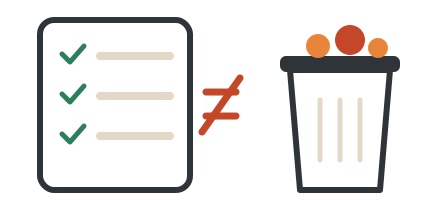
Done ≠ Arrived
Every important thing should come with an echo that says "it really arrived."
No echo, no assuming it worked.
UP NEXT

One Minute to Add, a Lifetime to Keep

Why things rot when anything can be built in a minute, how one developer kept 110,000 lines clean, and the same rules for a shop.
No. 16 · 4 minKeep going →
← Back to ELI5