You know better,
until the fight
Can't play sound? The illustrated version is right below.
Read the transcript
The full narration of the video.
Halfway through a fight, you know you shouldn't say it. It comes out anyway. Once you cool down, you remember: talk it through, don't shout. You know all the right things. So in those heated minutes, where did that sensible you go?
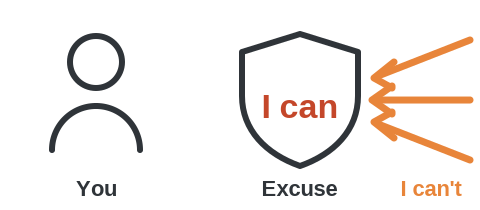
Let's look at the two things in your head that handle this. The part behind your forehead is like a desk lamp. Under it sits a note with what you know: pause first, no cruel words. Deeper inside there's something small, like a smoke alarm on the ceiling.
It doesn't read notes. It only asks one thing: is there danger? Yelled at, blamed unfairly, cut in line, it treats it all as fire. When it goes off, your body jumps into emergency mode: heart racing, muscles tight, a flood of chemical signals in your brain. And here's the strange part: the same flood makes the desk lamp dim, fast.
The lamp isn't off, and the note's still there. But you can't read it anymore. What takes over is whatever needs no reading: instinct, and your most practiced old habits. That's why what you shout is usually the lines you know best.
The lamp's real name is the prefrontal cortex, right behind your forehead. The alarm is the amygdala, one on each side, almond-sized, tucked deep in from your temples. Scientists have mapped this closely: under heavy stress, the prefrontal cortex briefly goes offline, while the amygdala and old habits get stronger. So when you lose it, it's not that you don't know better. The lamp you read it by has gone dim.
Here's the part that stings. When we're calm, we're sure we could hold it together when we're angry. Psychologists call it the hot-cold gap: from a cool room, it's hard to picture yourself in a hot one. So however good the note, it never planned for the lamp going dim. So write it differently: keep the note short, and write it ahead of time.
The quickest trick is to name the feeling. Say to yourself: I'm really angry right now. In experiments, naming the feeling quiets the alarm a little, and the lamp side lights up a bit. Another trick: make a deal with yourself while calm: if I want to yell, I step out for a glass of water first.
A plan made in advance needs no reading, it pops up on its own, like an old habit. It works better than willpower alone. None of this is a switch that works every time. When you're tired, hungry or short on sleep, the lamp is already dim, and it's harder. So in those heated minutes, skip the big lectures. Name it, and do what you agreed.
Last time you lost it, what words set you off?
One trick first
Next time a fight starts, say to yourself “I’m angry right now.” The heat drops a little.
Sounds too simple? Here is why it works. First, meet two things inside your head.
A desk lamp
and a smoke alarm
What happens
in those few seconds
The rules are not gone. The note is still there. The lamp you read it by went dim.
Once the lamp dims, the alarm and old habits take over. Your mouth beats your brain, and “You always do this!” comes out. In kids this lamp is still growing, so they have tantrums more easily.
Calm you can’t see
angry you
Simply put: a promise made while calm is not enough. Prepare something you can use when heated.
Two tricks
to try today
When you are tired, hungry or short on sleep, the lamp is already dim. Leave big talks for later.
It is not a switch
The lamp went dim.
Quick check
Why can't you recall the rules when a fight heats up?
The note is still there; the alarm went off and dimmed the lamp you read it by.