
An excuse isn't really for other people. It is a board you put between yourself and "I can't".
So the people best at making excuses are often not the ones who care least.
They are the ones most afraid they "really can't".
That is what makes excuses so powerful: they need no false words.
They just take a true fact and park it right behind the question "when will you do it?"
A famous 1978 experiment: people finished a test and were told "you did great". Then they chose a pill. One was said to boost performance, the other to hurt it.
Many picked the one that hurts.
If the next round goes badly, there is something to blame.
This isn't a willpower problem. Your mind is occupied.
A 2013 study gave the same set of tests to sugarcane farmers in India: once before harvest, once after. The same person scored clearly worse before harvest, when money was tight.
The researchers worked it out as roughly 13 points lost on an IQ test. The farmers didn't get dumber. "Not enough money" was running in the background all the time and filling their minds.
When your mind is full, you can only see the one square in front of you.
Explaining away a failure in advance is the cheapest way to live.
The energy saved has to last through tomorrow.
Because what you can see is different.
When it's you, you see the whole day: when you got up, how bad traffic was, what last-minute work landed, how your body felt. When it's someone else, you only see one result: they didn't hand it in.
The interesting part: psychologists used to think this bias was everywhere. A 2006 analysis pooling 173 studies found it isn't that widespread, but it does hold for failures and mistakes.
In other words, the bias is real exactly where it matters most.
Not making a resolution, not vowing, not "I will definitely do it".
It is turning "I will do it" into a sentence with a place and a time:
A 2006 analysis pooling 94 studies and over eight thousand people found that just rewriting an intention as a "when, where, what" sentence clearly raised the rate of follow-through, an effect that counts as medium to large in psychology.
Why does something so simple work?
Because an excuse can only block the question "should I do it?"
It can't block a time slot that is already written down. When the time comes there are only two options, do it or don't, and no third explanation.
The costliest mistakes don't throw errors: everything ran smoothly, yet the thing never arrived. A real incident, plus two rules you can use today.

Why things rot when anything can be built in a minute, how one developer kept 110,000 lines clean, and the same rules for a shop.
Nurses said they washed hands twice as often as they did. Why self-reports drift, why inspectors change behavior, and how to check for real.
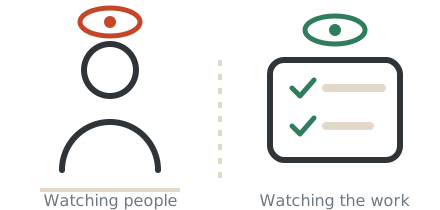
392 restaurants installed audit software: 22% less theft, 7% more sales. A factory hung a curtain: 10-15% more output. Watch the work, not the people.