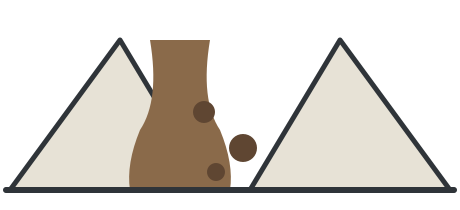
How big is
the sky in a well?
Can't play sound? The illustrated version is right below.
Read the transcript
The full narration of the video.
A frog sits at the bottom of a well. How much sky can it see? The old saying claims it thinks the sky is only as big as the well's mouth. This frog first appears in the Zhuangzi, an ancient Chinese classic, inviting a giant sea turtle down for a visit.
Before the turtle's left foot was even in, its right knee got stuck in the opening. So how big is the sky down there, really? Let's measure it for the frog. Picture an ordinary well: one metre across, with the water ten metres below the rim.
From the frog's eye, draw a line to each side of the rim. The two lines make a narrow angle of only about six degrees. How big is six degrees? The Moon looks about half a degree wide.
Only eleven Moons would fit across the frog's opening. Of the whole sky overhead, it sees just one eight-hundredth. Want to see it yourself? Roll a sheet of paper into a tube two centimetres wide and twenty centimetres long.
Close one eye and look up through it. Width to length is one to ten, just like the well, so what you see is the frog's sky. Now let the frog climb. Halfway up, it's five metres from the rim. How much more sky? Not twice as much. Four times.
To its eye, the opening is twice as wide and twice as tall, so that circle of sky has four times the area. Climb on, one metre from the top, and it's ninety times the sky it had below. One hop onto the rim, and the whole sky is back at once.
How much sky the frog sees has nothing to do with how clever it is. It's only how wide the opening is, and how far away. That angle between the two lines has a name: the angle of view. How big anything looks comes down to that angle. Back to the bottom. What passes through that little circle of sky?
The Sun would have to pass almost straight overhead to squeeze into that six-degree circle. But in Beijing, even at noon on its highest day of the year, the Sun stays more than sixteen degrees short. So a Beijing well frog could wait its whole life and never see the Sun cross the opening.
Only down south, around Guangzhou, does the summer noon Sun pass over for a little while. On summer nights, though, Beijing's wells do get a visitor. Vega, the Weaver Girl star, passes almost right over Beijing, taking over twenty minutes to cross from one side to the other.
If the well were twice as deep, twenty metres, how small a slice of sky would be left? Take a guess.
Let's measure it
One metre across, ten metres down: to the frog, the opening is only about six degrees wide.
Draw a line from its eye to each side of the rim. The narrow angle between them is all the sky it gets.
Room for just
eleven Moons
The Moon looks about half a degree wide. Across a six-degree opening, only eleven Moons fit.
Of the whole sky overhead, the frog sees just one eight-hundredth.
See it with
a paper tube
Roll a sheet of paper into a tube 2 cm wide and 20 cm long. Close one eye and look up through it.
Width to length is one to ten, just like the well. That little circle you see is the frog's sky.
Climb up, and the
sky grows fast
That angle has
a name
is all angle Lines from your eye to both edges of a thing make its angle of view. A wider opening, or a closer one, means a bigger angle. How much sky the frog sees has nothing to do with how clever it is.
Why is the sky blue? See this one.
Who passes overhead?
The Sun would have to pass almost straight overhead to fit into those six degrees. In Beijing, even at noon on its highest day, it stays more than sixteen degrees short.
A frog in a Beijing well never sees the Sun cross its opening.
Further south, around Guangzhou, the summer noon Sun does pass over for a little while. And on Beijing's summer nights, Vega passes almost straight overhead, taking over twenty minutes to cross the opening.
You may have heard that you can see stars by day from the bottom of a well. That's a myth: the well can't dim the bright patch of sky above it, so no stars by day.
Quick check
Why does the frog at the bottom of the well see so little sky?
Look through a 1:10 paper tube and you see the same small circle: it's all angle, not cleverness.