Can't play sound? The illustrated version is right below.
The full narration of the video.
Books, short videos, or AI: which one actually helps you learn? Here's the short answer: it's not where you learned it from, it's how hard your brain worked. A classic experiment. Two groups of students learned the same science passage.
Group A read it four times. Group B read it once, then closed it and wrote down what they remembered. Tested five minutes later, Group A remembered more. But a week later, Group A kept only forty percent, while Group B kept sixty.
The smoother it feels, the more you think you've got it. What sticks is what you had to work to recall. Short videos are quick and easy, great for learning that something exists. But they're so smooth, they easily make you feel you understand. Books are slower, but you set the pace: you can stop and flip back when you're lost.
AI lets you ask follow-ups and explains at your level. But it can also just do the work for you. In a Harvard physics course, an AI tutor that guided students step by step helped them learn more than twice as much as class. But at one high school, students who just asked AI for answers did worse than students who never used it, once the AI was taken away.
So use short videos as the menu, books as the meal, and AI as your sparring partner. Then close everything and explain it yourself. If you can say it, you've learned it. Next time something catches your eye, go read about it. Then let AI quiz you.
Whether you learn it
doesn't depend on where it came from.
It depends on how hard your brain worked.
A classic experiment: two groups of college students learned the same science passage.
Put simply: the smoother it feels, the more you think you know it. What actually sticks is what you worked to recall.
For informational texts, an analysis of 54 studies and more than 170,000 people found reading on paper led to slightly better understanding than reading on screens. For stories, there was no difference.
One small study (54 people, not yet peer-reviewed) also found that people who wrote essays with AI had a harder time recalling what they'd written.
It's not the length, it's who presses pause. The 8-second myth, the 6-to-9-minute sweet spot, two kinds of short, and what scrolling does.
Eight sentences from a 2,300-year-old Chinese book, one situation each: how to read someone by their choices when fortune changes, and what the method can't do.
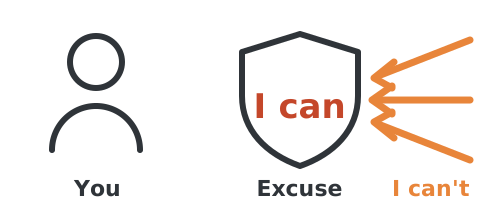
An excuse is a board between you and "I can't". How it differs from lying, why tight money makes it worse, and the one fix with evidence behind it.
The costliest mistakes don't throw errors: everything ran smoothly, yet the thing never arrived. A real incident, plus two rules you can use today.