Why thick ice
grows slower
for anyone who has seen one
Can't play sound? The illustrated version is right below.
Read the transcript
The full narration of the video.
Why does river ice freeze slower the thicker it gets? Picture a river that freezes ten centimeters of ice on its very first night. Yet reaching twenty centimeters takes four whole days.
Thirty centimeters takes nine. So how many days for a full meter? Take a guess. Hold that thought. Let's rewind and watch how the ice actually thickens.
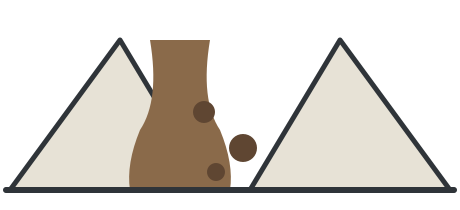
New ice doesn't pile on from above. It grows underneath, right where the ice meets the water. To turn into ice, water first has to give away its heat. That heat can only go up, through the whole layer of ice, and out into the freezing air.
The thicker the ice, the longer the trip, and the slower the heat escapes. It's like a winter quilt. The thicker the quilt, the harder it is for your body heat to get out. The ice is the river's quilt. On day one it's paper thin, heat slips right out, and the ice grows fast.
Double the ice, and heat leaks out half as fast, so the ice grows half as fast too. So every new layer is harder to make than the last. This has a name: heat conduction. Heat creeping, bit by bit, from warm to cold.
The bottom of the ice touches water at zero degrees. The top might sit at minus twenty. Heat creeps up through the ice between them. The ice's thickness is the quilt's thickness. The heat the water gives up is your body warmth. Do the math and a neat rule appears: twice as thick takes four times as long. Three times as thick takes nine.
A meter is ten times ten centimeters, so it takes a hundred times as long. About a hundred days. There's an old Chinese saying: three feet of ice is not the cold of one day. Three feet is about a meter, a whole winter of cold, saved up day by day. Add snow on top, and it's a real down quilt. Snow is full of air, heat escapes even slower, and the ice grows slower still.
This quilt also protects the water below. Deeper rivers and lakes never freeze solid, so fish spend the winter under the ice. Next time you stand by a frozen river, remember: the newest ice is growing at the very bottom, under your feet. Before watching this, how did you think river ice got thicker?
New ice grows
at the bottom
Ice does not thicken from the top. New ice forms where the ice touches the water.
To turn into ice, water must give away its heat. That heat can only go up, through the whole layer of ice, into the cold air above.
Each new layer
takes longer
Twice as thick takes four times as long. Three times as thick takes nine times as long.
The reason is simple. When the ice is twice as thick, the heat has twice as far to travel, so it escapes half as fast, and the ice grows half as fast. The days above are an idealized example. A real river also depends on how cold it is and how much snow there is.
Ice is the
river's blanket
Where the comparison breaks: a blanket is warm, ice is cold. Ice does not block the cold. It blocks the path the heat takes out.
Its real name:
heat conduction
Heat creeping from a warm place to a cold place is called heat conduction. The bottom of the ice touches the water, so it is 0 °C. The top may be −20 °C. The heat has to travel the full thickness of the ice.
Physicists call this Stefan's law: ice thickness grows roughly with the square root of how many cold days have passed. Very thin new ice (under about 10 cm) grows at a nearly steady pace at first. It slows down clearly only once it gets thicker.
Snow and fish
Three feet takes
a whole winter
A Chinese saying says "three feet of ice is not one day's cold". Three Chinese feet is about one metre. By the rule above, one metre takes about 100 days of cold.
On the Songhua River in Harbin, China, the ice can reach more than 60 cm in the coldest weeks, and workers cut ice blocks right on the river. The cold builds up day by day, and each later day adds less than the one before.
is the deepest under your feet
Quick check
On a frozen river, where does new ice form?
Water must give away heat to freeze. New ice forms where ice meets water, and that heat travels up through all the ice.