EXPLAINED SIMPLY
Why knots only
work in 3D
For anyone who has ever tied a shoelace
Video
Can't play sound? The illustrated version is right below.
Read the transcript
The full narration of the video.
On flat paper you can't tie a knot. In four dimensions, a knot won't hold. Only in our three-dimensional world does a rope stay knotted. Why three, of all numbers? First, a rule: this is the mathematician's kind of knot. Tie it, then join the two ends into a loop.
Leave the ends free, and you can pull any knot out from one end. So let's visit a few worlds, and try it in each. The first world is flat: forward and back, left and right, but no up or down, like a sheet of paper.
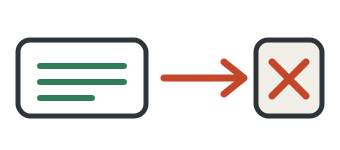
You loop the rope around and try to pass it over itself. But there is no "over" here. The two pieces just bump, and neither can get by. So on paper, a loop of rope is only ever a loop. No knot is possible.
Back in our 3D world, we have up and down, so the rope can finally cross over itself. It's like building an overpass. On flat ground, two roads can only meet at a junction; with a bridge, one runs above, one below, and they never touch. A knot is one loop of road with several of these bridges, over and under in turn.
To undo it, you'd have to swap one bridge, top for bottom. But rope can't pass through rope, just as a bridge can't pass through a bridge. So the knot is stuck, and pulling only makes it tighter. Mathematicians call this a knot, and study it in knot theory.
They draw one as a loop with a few crossings: the strand underneath is drawn with a small gap, to show it passes below. Each crossing is one overpass: which strand is on top and which is below is the whole secret of the knot. Now let's go one step further, into a four-dimensional world.
Besides forward, sideways and up, it has a fourth direction. We can't draw it, so we'll use color instead. When the rope moves a little that way, it changes color a little. This is just a picture of the idea. Now nudge the top strand of a bridge into the fourth direction. It turns red.
Red and white are on different levels, like two floors of a building. The red strand slides right through the white one, without touching. Move it back, and it turns white again. The bridge has swapped, top for bottom. Every bridge can be swapped like this. The knot comes apart crossing by crossing, until only a clean loop is left.
So three dimensions is just right: enough room for the rope to cross itself, but not enough for it to slip away. Yet in four dimensions, a thin sheet, like the skin of a balloon, can be knotted after all. Whatever the dimension of the thing, two more dimensions of space is where knots begin. A rope is one-dimensional, so it needs three.
What's the hardest knot you've ever had to untie, and where was it?
First, close the loop
With both ends free, you can pull any knot out from one end.
So a mathematician's knot is a rope loop with its ends joined.
Once joined, you can't pull it apart without cutting it.
On paper, a rope can't cross itself
A flat world has forward-back and left-right, but no up-down, like a sheet of paper.
The rope loops around to pass over itself. But there is no "over" here, so the two pieces just bump.
On paper, a loop
is only ever a loop.
3D works like an overpass
With up and down, the rope can finally cross over itself. On flat ground two roads can only meet at a junction; with a bridge, one runs above and one below, and they never touch.
A knot is one loop of road with several such bridges. To undo it you'd have to swap one bridge, top for bottom, but rope can't pass through rope.
So the knot is stuck, and pulling only tightens it.
Mathematicians study these in knot theory. In drawings, the strand underneath gets a small gap to show it passes below.
In 4D, rope passes through rope
A 4D world has a fourth direction. We can't draw it, so we use color: move the rope a little that way and it changes color a little. This is just a picture of the idea.
Nudge the top strand of a bridge into the fourth direction and it turns red. Red and white are on different levels, like two floors of a building, so red slides right through white without touching. Move it back, and the bridge has swapped.
Swap every bridge, and only a clean loop is left.
3D is just right
2Dstuck
3Dknots
4Dslips free
3D gives a rope enough room to cross itself, but not enough to slip away.
Yet a thin sheet, like a balloon's skin, can be knotted in 4D.
Knots begin when space has two more dimensions than the thing itself.
A rope is 1D, so it needs 3D; a sheet is 2D, so it needs 4D. The mathematician Zeeman proved this in 1960.
Where was the hardest knot you ever had to untie?
Shoelaces, earbud cords, kite strings: all stuck in 3D.
Quick check
Why does a knot come undone in four dimensions?
With a fourth direction, the top strand slides past on another level, so every overpass can swap, top for bottom, until the knot is gone.